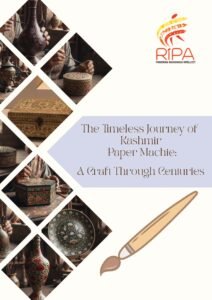
The Timeless Journey of Kashmir Paper Machie: A Craft Through Centuries
Kashmir Paper Machie, locally known as Kar-i-Qalamdan, is a living chronicle of Kashmir’s cultural exchanges, royal patronage, and artisan resilience. Its journey spans centuries, shaped by faith, royalty, empires, and evolving markets.
Kashmir paper machie is originated in the 14th century when Persian saint Mir Sayyid Ali Hamadani introduced the art. He brought 700 craftsmen from Persia and Central Asia to Kashmir. These craftsmen were skilled in molding paper pulp into decorative objects.
The oldest paper machie can be found in the Shah Hamdan Mosque (Srinagar). A place to explore and understand the beginning of Kashmir Paper Machie work.
15th Century: Royal Nurturing Under Sultan Zain-ul-Abidin
It was further developed in the 15th century by Sultan Zain-ul-Abidin, who brought artisans from Samarkand (now Uzbekistan). A new technique, called kar-i-qulamdan (pen case work), emerged, involving the shaping of paper pulp into delicate objects and painting intricate Persian-inspired designs.
Mughal Period Influence (16th-18th Century)
The Mughal era provided significant royal patronage, turning the craft into a luxury art form. The Mughal influence brought refined Persian aesthetics and motifs (floral designs, birds, intricate patterns) to the existing craft, which was originally used primarily for Qalamdani (pen cases).
British Empire Era
During British rule, Kashmir paper machie adapted to European tastes. The British highly valued these intricate items, leading to a shift in production toward decorative pieces, such as tea trays, writing sets, and decorative furniture, which were exported to Europe.
Post-Independence (1947)
After India’s independence in 1947, Kashmiri paper machie shifted from an elite to a commercial handicraft sector. While this made the craft more accessible, it also brought challenges, mass production, declining authenticity, reduced incomes for artisans, and competition from machine-made alternatives.
Current Era: GI Protection and Cultural Revival
A small group of artisans is still keeping this craft alive in Kashmir. They make boxes, bowls, vases, and other decorative and functional items.
To safeguard this century-old craft, the government recognised Kashmir Paper Machie with a Geographic Indication (GI) tag. This recognition promotes craft on the national and international stages and helps artisans to understand the GI business. It also provides fair trade opportunities and protects the craft from cheap imitation.